

How to Avoid Unnecessary Expenses – Simple Ways to Save Money Daily
How to Avoid Unnecessary Expenses (Simple Ways That Actually Work)
If you have been pondering how to avoid unnecessary expenses, I am sure you will realize that money is not disappearing into thin air. It is disappearing in small ways, in small decisions that are not really taken into consideration. That one extra order, that one random purchase, that one moment when we say to ourselves, “It is just once.” Understanding how to avoid unnecessary expenses is not really about control. It is more about understanding these moments before they become habits.
What is fascinating is that most people are not even aware of when they are losing money. You feel that you are not really spending a lot, and yet when the month is over, you feel that something is just off. And that is when understanding how to avoid unnecessary expenses begins. You can also explore how small habits impact your spending patterns in detail in this guide on breaking bad money habits.
What Are Unnecessary Expenses?
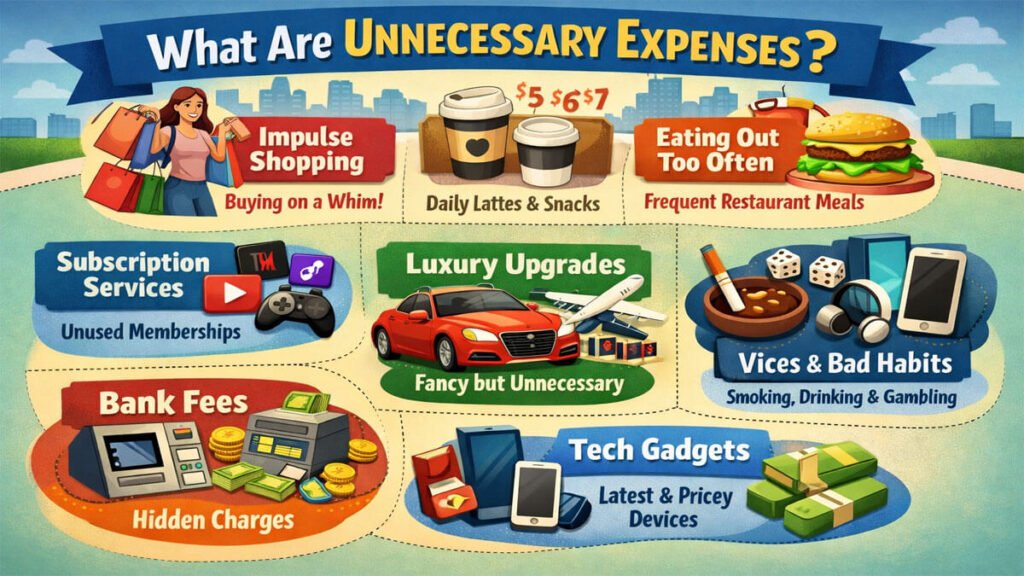
But before that, it is helpful to pause and think about what are unnecessary expenses because the answer is not as obvious as it seems. When asked what are unnecessary expenses, most people think of large and reckless spending. However, this is not as simple as that.
In most cases, it is normal and reasonable spending. Buying something because it is on sale. Eating something because you are tired. Subscribing to something you thought you’d use but never did. These are the kind of things that fall under what are unnecessary expenses, not because they are “wrong,” but because they don’t really add value in the long run. Many of these behaviors are closely linked to emotional triggers, which are explained well in this article on emotional spending patterns.
And the tricky part is—they feel justified in the moment. That’s why they repeat. Once you start noticing these patterns, your understanding of what are unnecessary expenses becomes clearer, and that’s when change actually starts.
12 Unnecessary Expenses You Should Stop Today
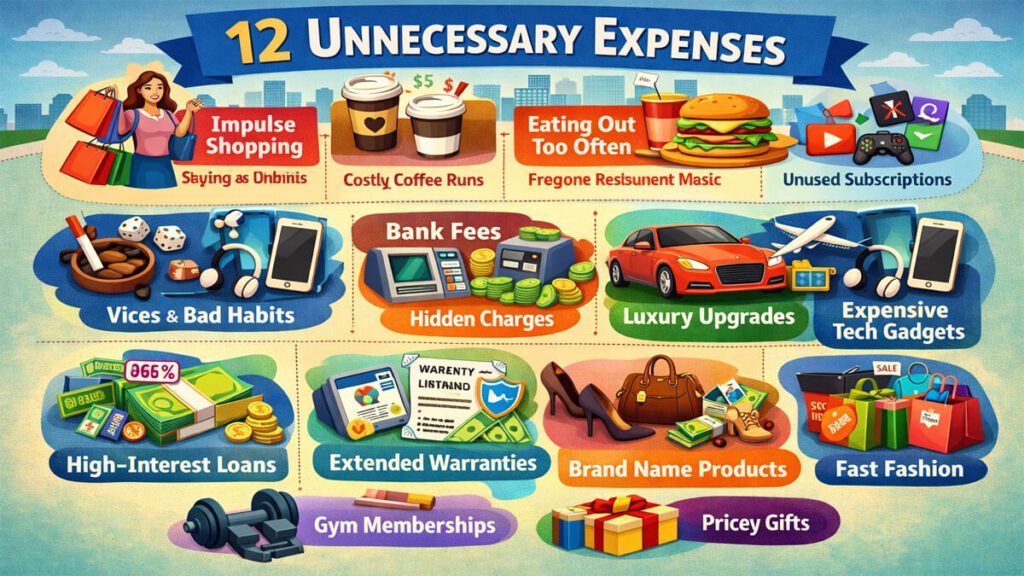
If you try to think about this by yourself, it can be quite vague. So, it’s better to look at examples. There are some patterns that occur repeatedly, and these 12 unnecessary expenses are quite common in our lives.
Like, for instance, eating out too often, paying for services we forgot we were paying for, or buying things just because they’re discounted, or even paying for things to be convenient, while we could plan to save money. This is exactly how online sales influence our decisions, and understanding discount psychology in online shopping can help you become more aware of these spending triggers. The 12 unnecessary expenses don’t look like much, and that’s why we don’t even notice them.
If we look at this from a bigger perspective, we can understand how these 12 unnecessary expenses can affect our lives. The 12 unnecessary expenses are not really about money; it’s more about habits, and habits, after being done repeatedly, become automatic.
How to Stop Unnecessary Expenses
The question of how to stop unnecessary expenses can be quite frustrating, particularly if you have already attempted to do so in the past and failed. Most people’s solution to this is to resolve to “be more careful,” but this wears off after a few days.
The reason for this is simple: decisions in the moment are always emotional decisions. So, in order to really understand how to stop unnecessary expenses, you have to make those moments more easy to manage.
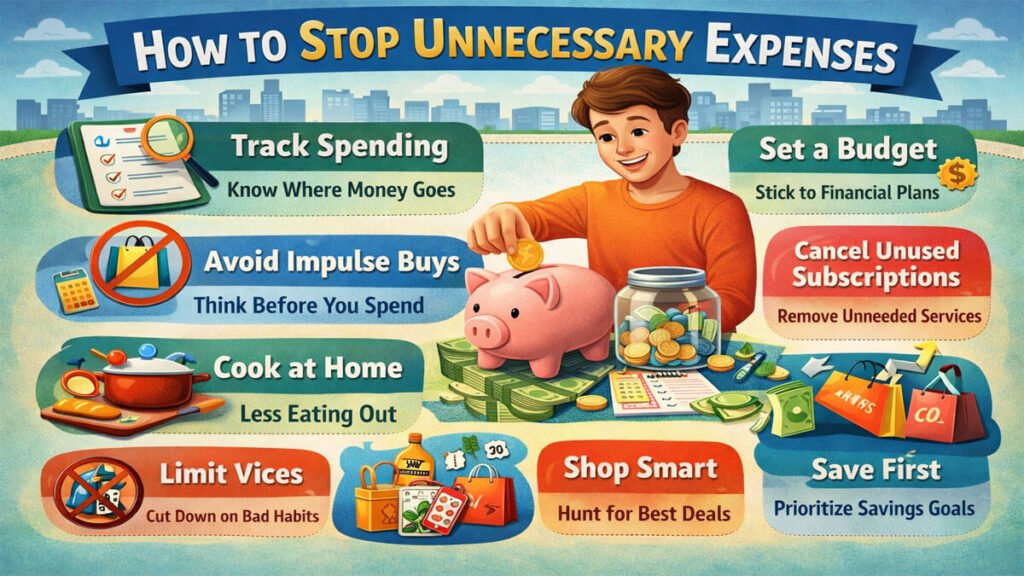
One thing that can really help is to remove saved credit card information, for instance, because this forces you to stop and re-enter it. This can be quite powerful, because it forces you to stop for just one second and reconsider. A similar approach is explained in the 72-hour rule for spending, which helps create a pause before buying. Over time, this can really teach you how to stop unnecessary expenses, even if you do not force yourself too much.
Another thing that works surprisingly well is to write down how much you spend for a few days, even if it’s not perfectly or in detail. Once you really see it, you don’t even need to be motivated to stop, because you will be naturally drawn to how to stop unnecessary expenses.
How to Reduce Unnecessary Expenses in Daily Life
There’s a difference between stopping and adjusting. That’s where learning how to reduce unnecessary expenses becomes useful, especially if you don’t want to feel restricted.
Instead of cutting everything out, you start making small shifts. Maybe you don’t stop ordering food completely, but you do it less often. Maybe you still buy things you like, but not impulsively. These small adjustments help you gradually reduce unnecessary expenses without turning it into a strict system. If saving consistently feels difficult, this guide on saving money from your salary every month can give you a clearer structure.
And honestly, that’s what works long-term. When something feels too rigid, it doesn’t last. But when it feels manageable, you stick with it. Over time, you naturally reduce unnecessary expenses without even thinking about it too much.
How to Avoid Unnecessary Expenses (A More Real Approach)
At some point, everything comes together, and you start to understand how to avoid unnecessary expenses in a way that actually fits your life. It stops feeling like a rule and starts feeling like a habit.
One thing that helps is simply delaying decisions. Not forever—just a little. That space between wanting something and buying it changes a lot. It gives your mind time to settle. And that’s often enough.
Another thing is noticing why you want to spend in the first place. Sometimes it’s boredom. Sometimes stress. In many cases, this is connected to money anxiety and spending behavior, which affects how we make financial decisions. Sometimes just scrolling too much. Once you see that, learning how to avoid unnecessary expenses becomes less about control and more about awareness.
And honestly, you don’t have to get it perfect. Even small improvements matter. The goal isn’t to eliminate spending—it’s to make it more intentional.
Why This Is Harder Than It Looks
Even when you understand how to avoid unnecessary expenses, there are days when it still doesn’t work. And that’s normal.
Spending is not always logical. A lot of it is emotional. You don’t always buy things because you need them—you buy them because they make you feel something, even if it’s temporary.
That’s why being too strict usually backfires. When everything feels restricted, you eventually give in. But when you understand what’s happening underneath, learning how to avoid unnecessary expenses becomes less stressful and more natural.
Final Thoughts
Ultimately, learning how to avoid unnecessary expenses is not about cutting everything out or being super disciplined and stuff like that. It’s just about being aware a little, and then just keeping going.
And then, slowly but surely, things just start changing and stuff, and you just kind of get more in control and everything is just great.
That’s really what learning how to avoid unnecessary expenses is all about, not about restriction, but just about being aware.
FAQs
How to Avoid Unnecessary Expenses?
The first and foremost thing that you need to understand and learn while learning how to avoid unnecessary expenses is the awareness of the way you are spending your money, especially on a day-to-day basis. It is only when you are able to understand and comprehend the way you are spending your money that you will eventually be able to gain better control over your spending habits without feeling restricted. The key here is to keep on spending, just in a different manner.
What Are Some Unnecessary Expenses?
First and foremost, it is very important to understand and comprehend the fact that when we are learning what are some unnecessary expenses, we are talking about food delivery, services that are not being used, impulse purchases, and buying things just because they are on sale. Moreover, we are also talking about coffee, last-minute purchases, and other things that are convenient for us. All of these can eventually turn out to be very expensive, despite the fact that they are of a very small nature.

Rajat Sharma writes about human behaviour, money habits, and the quiet patterns that shape everyday decisions. Through simple, reflective writing, he explores why we think the way we do — from emotional spending to productivity and personal growth. His goal is not to give rigid advice, but to help readers notice the subtle habits that influence their lives.